Is Your AI Stack Keeping Pace with the Market?
Equivalent intelligence now exists across proprietary, open-source, and locally hosted models. The organizations that get the best available intelligence at the lowest sustainable cost are the ones that run on evaluation-driven discipline: every model earns its traffic against measurable quality. That discipline runs on a four-stage loop: ACT, OBSERVE, LEARN, ADAPT. Most teams have ACT and OBSERVE covered. Automatic learning and adoption, while preserving production guarantees, is what almost no stack has built.
What each step actually does
ACT covers routing and serving: pure routers (Martian, Not Diamond, RouteLLM) and gateways (LiteLLM, Portkey, Cloudflare AI Gateway) live here. They are stateless by design: they do not know whether last week's responses were good, and they do not self-adjust.
OBSERVE captures what happened and whether it was any good: latency, cost, outputs, and quality scores. Arize, Langfuse, Braintrust, LangSmith: these tools all observe. The difference between them is depth: from counting and aggregation to structured evaluations. But every signal they surface is waiting for a human to act on it. Note that observing quality requires a definition of quality first: EvalMate is where you define it, turning a few representative examples into measurable criteria (rubric, aligned judge, reward model) that become the system of record for what "good" means for each agent.
LEARN is where signals become decisions: which models have degraded and should lose traffic, which have improved and should gain it, where the cost-quality frontier has shifted. Without automation, this falls back to engineering review cycles: read the leaderboard, benchmark a candidate, update the config. It is periodic at best, and almost never timely.
ADAPT is what happens when the system acts on what it learned: updating routing weights when a cheaper model now passes quality thresholds, migrating traffic when a new model improves the cost-quality frontier, adjusting the cost-quality tradeoff as provider prices shift. This step requires the first three to be connected and running continuously. Built from four separate tools, it does not happen automatically. It happens when an engineer has a sprint for it.
Winning teams invest their engineers in product, not infrastructure management. They know their core. They leave the compounding to Divyam.AI.
Why the gap persists
Each tool category is solving the problem it was designed for. No more, no less.
- Routers dispatch fast and stateless. They were not designed for eval-driven weight updates.
- Gateways unify API access. They were not designed to shift routing priorities based on quality signals.
- Eval frameworks produce scores. They are not wired to act on them.
- Observability tools surface signals. They do not close them into decisions.
How Divyam.AI closes the loop
Divyam.AI is designed as a closed-loop system. EvalMate defines quality and holds the system of record: the criteria, datasets, prompts, results, and drift for every agent over time. The Router deploys that quality intelligence in production, scoring each request continuously and selecting the best-fit model across quality, latency, and cost, so every model earns its traffic across proprietary, open-source, and locally hosted options. It continuously and autonomously optimizes your LLM stack: routing intelligently, learning from every cycle, adopting better models as they emerge, and never locking you into one provider. The compounding runs. You focus on what matters.
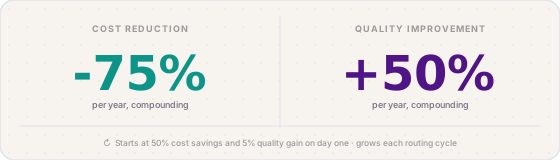
And if your evals are not good, the loop has nothing reliable to optimize against. Divyam AI's EvalMate is where you fix that: it surfaces the gaps in how you have defined quality and prompts you to address them, so the criteria driving every routing decision are ones you trust. Imagine how much it increases the chances of success for your product.
Ready to see how the platform is actually built? See the Divyam.AI platform at a glance →
For the full deep-dive into what production-grade agentic AI actually requires, read Taking Your LLM Application to Production →